Dr. Slop
The Life and Opinions of Tristram Shandy, GentlemanDr. Slop is the man-midwife summoned when Mrs. Shandy goes into labor, a practitioner whose new instruments promise technical intervention but whose arrival and conduct repeatedly turn professional authority into comic disorder. Set against Mrs. Shandy’s insistence on choosing her own midwife and Walter Shandy’s faith in medical theory, he embodies the novel’s uneasy, often satirical encounter between obstetric expertise, family decision-making, and the unpredictable business of birth.
Identity and Professional Authority
Walter favors Dr. Slop because the doctor has written on midwifery and has expressed support for extracting a child by the feet, an approach that happens to accord with Walter’s own theory. Slop’s professional position therefore serves Walter’s intellectual and domestic purposes at once: he is not simply a practitioner called in during an emergency, but a medical authority whom Walter believes can help realize a preconceived plan.
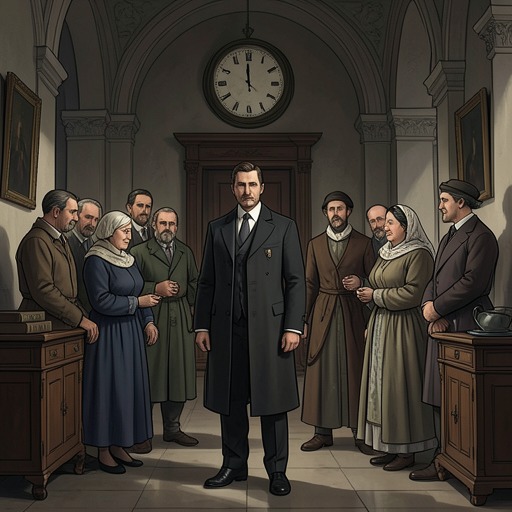
The narrator’s first description makes Slop’s physical presence part of his comic characterization. He is short and squat, with a broad back and conspicuously large belly. When Obadiah brings him into the house after his mishap on the road, Slop arrives uncleaned and disordered, and stands speechless at the parlor door. His appearance does not disprove his expertise, but it sharply undercuts the composed, commanding professional figure that his reputation might suggest.
Summoned to the Birth
The choice to summon Slop is contested before labor begins. Mrs. Shandy plans to use the old midwife, while Walter wants the man-midwife. He presses her to let him choose; she insists that the choice is hers. Their disagreement exposes the domestic stakes behind Slop’s employment: his presence is not an agreed household arrangement but the result of Walter’s preference, set against his wife’s stated wish to rely on the traditional practitioner.
When Mrs. Shandy’s labor begins, Susannah runs to fetch the old midwife. Walter separately orders Obadiah to ride for Slop and asks that he return quickly. The two routes to the birth thus represent the unresolved division in the household: the midwife Mrs. Shandy chose and the doctor Walter wants are both brought into the crisis.
Slop’s journey makes his entrance less like a controlled intervention than a chain of mishaps. While crossing himself, he lets go of his whip; trying to save it, he loses his stirrup and then his seat. He falls from his pony and ends up stuck in the mud. Obadiah brings him in without first making him presentable, so the doctor reaches the house in a condition that makes his arrival itself a scene of embarrassment.
Instruments and Obstetric Dispute
Slop’s professional identity is closely associated with his newly invented forceps, which he defends as a safe means of delivery. But on the journey to the Shandy house he has left his instruments behind, including his forceps and other obstetric tools, in the green baize bag near his pistols. The practical failure is also a structural joke: the doctor who arrives as the household’s technical solution cannot immediately act because the equipment on which his authority depends is elsewhere.
The narrator places this mishap beside Walter’s competing theory. Walter is interested in delivery by the feet not for the reasons Slop gives in his book, but because it fits Walter’s own account of the child’s welfare. His decision to call Slop thus does not mean that the two men share a medical rationale. Slop supplies professional standing for a course Walter has already imagined, while the doctor’s own expertise remains attached to his preferred instruments and obstetric reasoning.
During the labor, the account multiplies the practical complications: Mrs. Shandy is in distress, her pains cease, the medicine is gone, the nurse has been hurt, the child has not advanced, and the old midwife has fallen and bruised her hip. Slop offers to examine the midwife, but Susannah redirects him toward Mrs. Shandy. The episode presents childbirth not as a neat demonstration of medical mastery but as a crowded, competing emergency in which attention, authority, and practical help are repeatedly misdirected.
The Birth and Its Consequences
The novel connects Slop’s instruments with Tristram’s damaged nose. Walter hears from Susannah that the doctor’s instruments crushed the child’s nose, and that a makeshift bridge is being fashioned from cotton and whalebone taken from Susannah’s stays to raise it. The detail gives the consequences of obstetric intervention a lasting place in the family story: the child’s body bears a mark attributed to the very practitioner brought in to manage the birth.
Slop’s later presence in discussions of Tristram’s condition keeps medical explanation in contention rather than settling it. When Walter asks what the child’s condition amounts to, Slop predicts a phimosis. Elsewhere he discusses radical heat and moisture as foundations of life, while Walter advances his own version of that theory and Yorick challenges him to substantiate it. Slop can participate in learned medical conversation, but the novel makes such claims part of a wider comedy of competing systems and confident assertions.
Temper, Reputation, and Narrative Role
Slop’s authority is further complicated by his encounters with Susannah. After a disagreement over whether she should hold a candle while he applies a poultice, the exchange escalates into reciprocal retaliation: Slop throws the poultice at Susannah, and she returns what remains in the pan. The episode turns a small dispute over decorum and care into open conflict, giving Slop a quick temper that sits uneasily beside his professional role.
The narrator also charges Slop with magnifying the consequences of Susannah’s later accident. A report about the nursery window spreads through the household and beyond; the story grows more serious as it is repeated, while Walter finds that denying it may strengthen belief just as silence may appear to confirm it. The text presents Slop as contributing to this inflation of the event and its public reputation, though it does not make him the only force behind the rumor’s circulation.
Slop’s comedy arises from the repeated distance between what his office promises and what the episodes deliver: the expert loses control of his ride, arrives without the instruments central to his practice, becomes embroiled in quarrels, and is associated with injuries and exaggerated reports. Yet he is not merely a bungler. His medical arguments and his forceps give him a recognizable professional position, even as the narrative subjects both expertise and reputation to scrutiny. Through him, birth becomes a site where technical confidence, competing knowledge, household power, and accident meet without producing the orderly mastery Walter seeks.